
 3 min
3 min
Most of us evaluate our work through results. Are the goals met? Is the work done? Are managers satisfied?
These are important questions. But there is one even more important question that is asked far too rarely:
Does this job fit my natural energy – or does it require constant effort from me?
This question is where the path begins toward either sustainable well-being at work or slow, silent burnout.
Good Results Do Not Always Mean the Right Job
Many people perform very well at work. They take responsibility, push themselves, and handle even demanding tasks. Often, they are praised for it.
But sometimes this performance comes at their own expense …
Workplace Big Five helps bring clarity here by separating two things that are often confused in everyday working life:
Work performance – what a person delivers and how well
Natural energy – how natural or exhausting that work actually is for the person
Workplace Big Five does not measure how well someone performs. It shows how much natural energy it takes for that person to do the job.
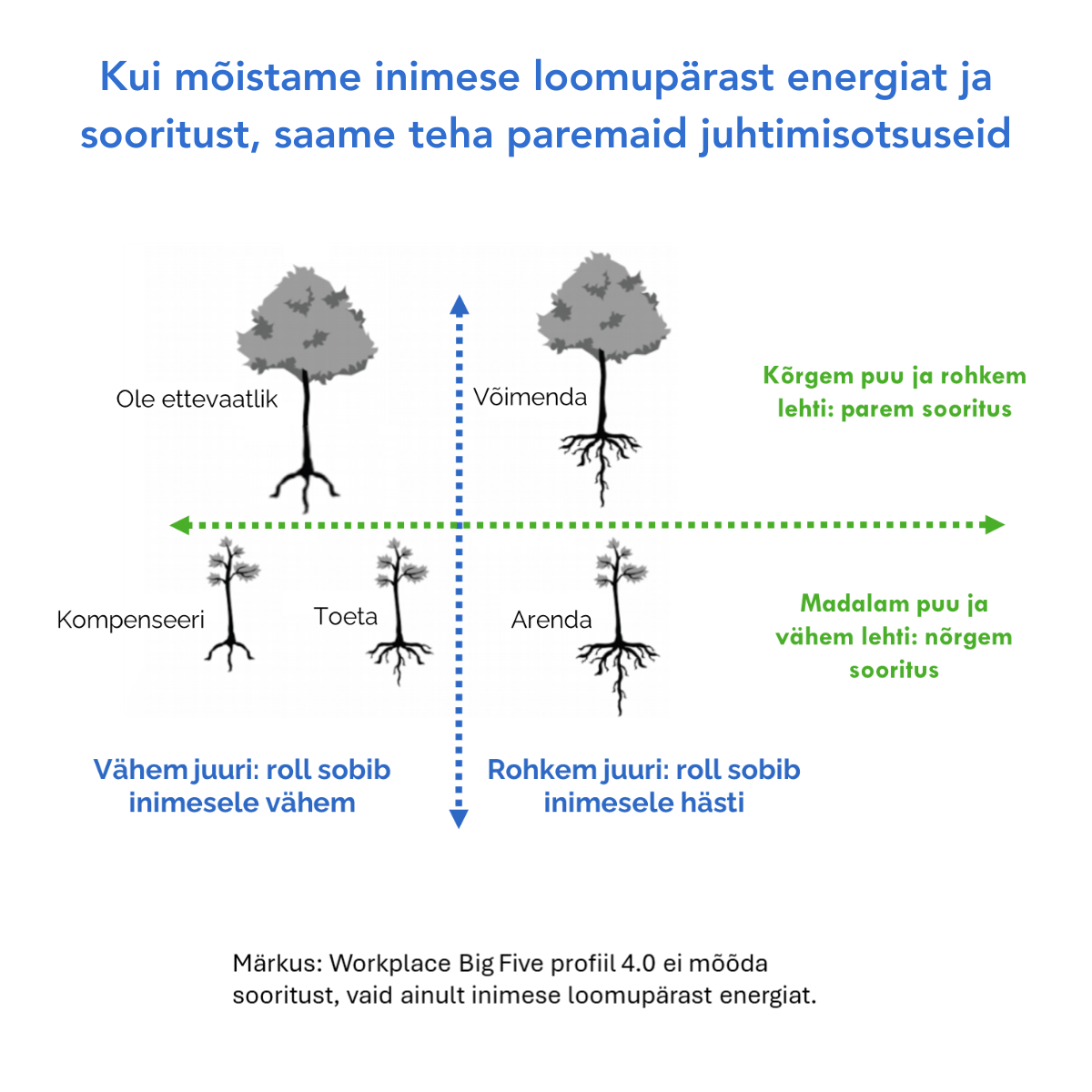
The Tree Metaphor: A Simple Way to Get to the Core
To explain this, Workplace Big Five uses a very simple and intuitive metaphor – a tree.
The roots represent a person’s natural energy. They show whether the work fits the person naturally or not.
The height of the tree and its leaves represent actual work performance.
The more roots there are, the more natural the work feels. The fewer the roots, the more a person has to compensate and push themselves.
When Energy and Performance Are Viewed Together, Clarity Emerges
When we look not only at results, but also at how a person actually feels in their work, the picture becomes much clearer.
Based on this understanding, Workplace Big Five identifies five typical situations that occur in working life.
When the Job Gives Energy – Capitalize
The job fits the person’s natural energy and results come almost effortlessly.
This is the moment to use strengths deliberately, give responsibility, and align personal and organizational goals.
When Results Are Good but the Person Is Tired – Caution
Everything may look fine on the surface, but the job does not fit the person’s natural energy.
Constant effort and accumulated fatigue create a high risk of burnout.
When the Job Fits but Skills Need to Grow – Develop
The person has natural energy for the role, but skills or experience need time to grow.
Learning, coaching, and experience make the difference.
When Results Depend More on the Environment – Support
The challenge lies not in the person, but in how the work is structured.
Clearer roles, better leadership, or adjusted expectations can help.
When the Job Does Not Fit – Compensate
The job does not fit the person’s natural energy and results suffer.
The solution is not more effort, but redesigning the role or finding a better fit.
This is not weakness; it is thoughtful and humane leadership.
Why Workplace Big Five?
It helps answer a question most tools never ask:
Does this job give a person energy – or take it away?
Workplace Big Five is based on the scientifically validated Big Five model, designed specifically for the workplace, and helps identify burnout risks before they become real problems.
Good leadership does not begin with the question: “Can this person cope?”
It begins with: “Does this job fit this person’s natural energy?”
Workplace Big Five provides a clear, honest, and practical answer.

