
 4 min
4 min

Have you ever been in a situation where two people leave the same meeting but feel completely differently about it?
One says, “That was a really good discussion.”
The other sighs, “That was exhausting and confusing.”
The same situation. The same words.
Yet a completely different experience.
This is where perception begins.
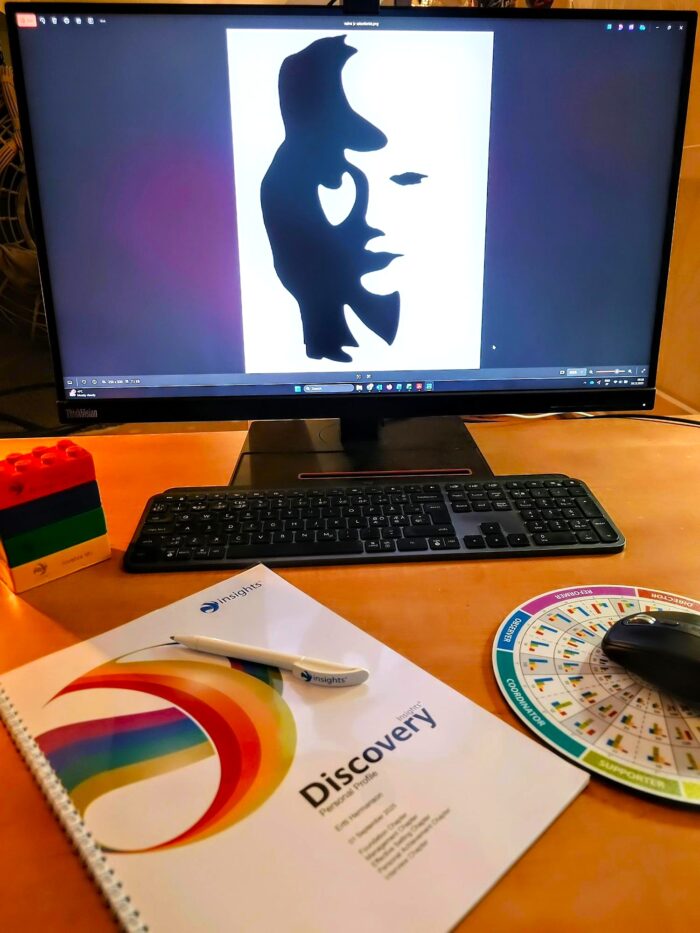
One Image, Two Very Different Experiences
Take a moment and look at the image on the screen.
Some people see a young woman in profile.
Others see a man playing a saxophone.
What’s interesting is that neither is “wrong”. And neither is “more correct”.
Yet once you’ve seen one version, it can be surprisingly difficult to see the other – even when someone tells you, “There’s something else there.”
This is one of the simplest, and most honest, examples of perception.
Perception – the Invisible Filter Between Us and the World
We like to believe that we see the world objectively. That facts are facts, and situations are simply the way they are. In reality, every experience has already passed through a filter before it reaches our awareness – the filter of perception.
Perception is how we notice, interpret, and give meaning to everything around us.
We don’t respond to events themselves, but to how we see and understand them.
Just like with the image: the world is the same, but what we notice is different.
And perhaps the most fascinating part is this – we usually don’t notice our own perception at all. It simply feels like reality.
Why Do We So Often Talk Past Each Other?
If you’ve ever caught yourself thinking:
- “Why can’t they see what really matters?”
- “Why are they reacting so emotionally?”
- “Why do they always take so long to decide?”
…then you’ve already encountered differences in perception.
We tend to assume that others are seeing the same “picture” we are. And when they don’t, it can feel confusing – sometimes even frustrating. Yet in truth, we are never looking at exactly the same picture. Each of us has our own perspective.
Jung’s Simple but Profound Insight
More than a hundred years ago, Swiss psychiatrist Carl Gustav Jung observed that people don’t differ only in how they behave. They differ in how they perceive the world.
Some people notice facts and logic first.
Others are more attuned to emotions, atmosphere, and relationships.
Some see possibilities and the future; others focus on risks and details.
These differences are neither good nor bad. They are natural – just like whether you first saw the young woman or the saxophone player in the image.
Why Does Insights Discovery Start with Perception?
Insights Discovery doesn’t begin with the question, “How do you behave?”
It starts at a deeper level:
“How do you perceive the world?”
Because behaviour is always the visible outcome, not the root cause. When we understand what a person sees, their behaviour becomes far more logical and easier to understand.
Often, tension and misunderstandings aren’t caused by bad intentions. They arise from different perceptions – and that’s something we can learn to notice.
The First Step Toward Self-Awareness
Understanding perception begins with ourselves.
What do I notice first?
What do I tend to see as “obvious”?
And what might I not see at all until someone points it out?
Insights Discovery uses four colour energies to make these differences in perception visible. They don’t describe who we are, but the lens through which we tend to view the world.
But before the colours, there is this first realisation:
We all see the world a little differently!
A Closing Reflection
Perhaps it’s not people who are complicated.
Perhaps what’s complicated is forgetting that others may be seeing an entirely different picture.
When we learn to notice our own perception, we create more space for understanding – both for ourselves and for others.

