
 7 min
7 min

How My Journey of Self-Discovery Began
I believe it was in the summer of 2007 when my attention was caught by a Kanal 2 television interview with trainer and consultant Aira Tammemäe. In the interview, Aira shared her experiences from her first leadership training on the Camino de Santiago – a journey she had led for a group of Estonian leaders on the ancient pilgrimage route in Northern Spain.
It was a collection of practical exercises created for her psychology master’s thesis, designed to explore how a group of strangers behaves in unfamiliar conditions – including in altered states of consciousness brought on by fatigue.
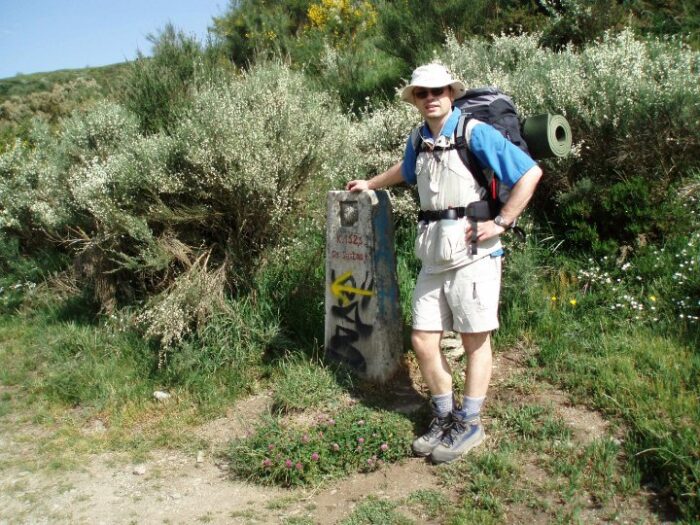
As I watched the interview, the entire world stopped around me. I felt as if the message was directed straight at me, calling me to join that journey. The very next morning, I contacted Aira and asked my employer for two weeks of vacation. Everything unfolded quickly, and just a couple of weeks later I found myself in Spain with nine senior leaders I had never met before. With a backpack on my shoulders, I was about to begin an adventure on the 1,200-year-old pilgrimage route near Villafranca del Bierzo, with the goal of reaching the Santiago de Compostela Cathedral one week later.
My First Encounter With Jung’s “Shadow”
I will not retell all the exercises Aira “tested” on us during that journey, but they all had one thing in common: pushing participants out of their comfort zone to spark self-discovery. And so it happened that on the evening of the third day, during yet another exercise, I consciously met my “shadow” for the first time.
C. G. Jung describes the “shadow” as the part of the psyche where a person suppresses qualities, emotions, and impulses they do not want to acknowledge in themselves – or that society does not approve of.
I remember it as a deeply painful experience that radically changed my self-image. I initially refused to accept my negative traits and even felt quietly resentful toward Aira for “forcing” me to confront them.
Two weeks after the training, when we were already back in Estonia, I invited Aira to lunch. By then, I had come to terms with my “darker side” and made peace with it. I thanked her for an excellent training and for the opportunity to discover myself. I also told her how I had secretly felt offended during the journey. Fortunately, she hadn’t noticed it at all – and looking back, we both found it almost amusing.
To this day, I consider Aira one of the most influential people on my spiritual path. Later, we travelled together on several more journeys — both on the Camino de Santiago in Spain (2009, where I joined as Aira’s assistant) and to Mount Kazbek in Georgia (2009).
Stepping Into the World of Transpersonal Psychology
After my first Camino journey, I felt like a different person. My curiosity about human nature and personal development grew stronger: Who are we, really, and what shapes the way we think?
I began reading various books on philosophy and psychology, which gradually led me deeper into the world of transpersonal psychology.
Transpersonal psychology refers to human experiences that transcend the boundaries of the ordinary personality (the persona). It points to levels of consciousness where a person experiences themselves as something broader than their ego, roles, or personal identity.
The Literature That Changed My Worldview
To begin with, I read all of Carlos Castaneda’s works that had been published in Estonian. The encounters and conversations he described with the Toltec warrior Don Juan opened up a world where the transformation of personality and consciousness was not some mystical end goal, but a practical path. A central theme running through Castaneda’s books is that profound change begins with perception – with how a person relates to themselves and the world around them.
The books were so captivating that, while reading, I often felt as if I were in an altered state of consciousness myself. Don Juan’s teachings expanded my understanding of identity, inner freedom, and the limitations of our habitual sense of reality.
One idea from Don Juan resonated with me especially strongly:
“We do not see the world as it is, but as we were taught to see it.”
This claim forms the backbone of Castaneda’s work. According to Don Juan, the world is not the sum of the objects in front of us, but our interpretation of them. Our experiential “reality” is shaped by the meanings and patterns we have been taught to notice. When interpretation changes, the entire structure of our experience changes – as if a door to another world opens.
In other words: we all perceive the world the way we are accustomed to perceiving it. But these habits are not set in stone; they can be transformed. When we change what we focus on and how we perceive things, our experience shifts accordingly — revealing something new both within us and around us.
From there, I delved deeper into the topic of consciousness development. One of the most influential authors for me was Ken Wilber, whose comprehensive works describe, among other things, the three major stages of human consciousness development: the pre-personal (pre-rational, instinctive), the personal (the development of the rational ego), and the transpersonal phase (transcending the ego and expanding spiritual awareness).
One of Wilber’s thoughts that helped me understand consciousness development more profoundly was:
“Transcending means including, not dissociating. We transcend and include.”
This made me realize that true growth does not mean ignoring or eliminating the ego but allowing it to mature and integrate with all the inner layers of our being.
Jung and the Deeper Layers of Consciousness
This understanding paved the way for my next major discovery – Carl Gustav Jung’s concept of individuation, which explores the transcendence of the ego and the integration of our inner parts on an even deeper level. Jung writes:
“Individuation is the fundamental task of our life.”
Individuation means realizing the unconscious potential within us. Each of us carries immense creativity, energy, abilities, instincts, and archetypal forces – most of which remain hidden until we consciously encounter them and integrate them into our whole being.
Personality Types and Insights Discovery
In addition to his theory of individuation, Jung also developed a system of personality types. Jung’s typology is based on two foundations: the attitudes of extraversion and introversion, and the four primary functions through which we perceive the world – thinking, feeling, sensation, and intuition. Jung explains that sensation tells a person that something exists; thinking tells them what it is; feelings show whether it is pleasant or not; and intuition reveals where it comes from and where it may lead.
These ideas have formed the basis of many modern personality assessments, such as the MBTI and Insights Discovery, which apply Jung’s principles in a contemporary and practical way.
How My Inner Journey Led Me to Insights Discovery
Throughout this journey, I’ve learned that real change always begins with awareness. I have seen teams for whom a single Insights Discovery workshop is enough to noticeably improve relationships and collaboration. Not because someone gives them an external “trick,” but because they begin to see one another with fresh eyes – noticing styles, needs, and inner attitudes that were previously invisible.
Today, as an Insights Discovery facilitator, I help people understand both their own and others’ behavioural patterns in a clear and simple way – using the universal language of colour that makes psychological nuances easy to grasp in everyday communication. This is precisely why Insights Discovery fits so naturally with my earlier path: it translates deep principles of self-awareness into practical skills that can be applied immediately in real life.
The strength of this model lies in the fact that it doesn’t require people to “change who they are,” but instead helps them see their natural strengths and understand the small adjustments that make collaboration, leadership, and communication significantly smoother.
In my next blog post, we will take a closer look at the practical benefits Insights Discovery offers for leaders and teams.

